


Single Screw Pasta Making Machine
The single screw extruder pasta machine are loaded with powerful parts that are highly effective even when consuming low electric currents to help you save on your electricity bills. Take advantage of the different models and sizes that allow you to keep them anywhere in your facility.
Rich Experience
Our working team have experienced more than 10 years on extrusion processing.It is one specialized is engaged in the twin-screw and single screw food expanding machinery enterprises, company with research and development, production, sales of all kinds of machinery and complete sets of equipment for the main business, my company brings together industry expert team work for ten years, not only in the best extrusion technology research, more efforts to continuously explore in terms of food technology, so that the customer production to the market leading food.
Wide Product Range
Our mainly products: Snacks food extruder, fish food machine, dog food machine, pet food machine, puff snacks machine,core filling snacks machinery, Corn Puff Snack Extruder, pet chews food machine, pet snacks machine, corn flakes production line, lab twin screw extruder, twins screw extruder, double screw extruder, niknaks machine, cheetos food machine, textured soya protein food machine, soya nugget machine, pellets snacks production line, and so on…
Excellent Customer Service
Installation + training: After delivery, according to the needs of the purchasing customer, the after-sales service personnel will arrive at the designated place of the customer, to install the equipment in time.
Service + tracking: After-sales service personnel need to do a follow-up survey of each customer responsible for their own use of equipment, and conduct detailed records and targeted problems to solve.


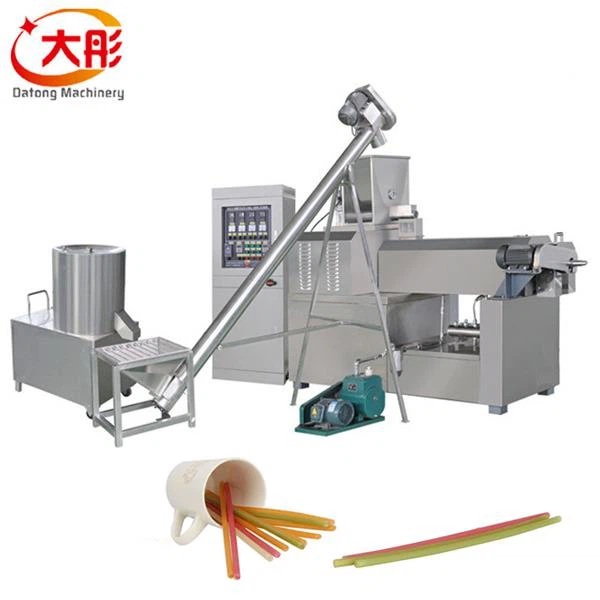


Main Features of Pasta Macaroni Making Machine
Vacuum Extrusion (230 Width) Molding
The dough sheet is produced while vacuuming, which can make a very dense dough.
Chip Molding
Support high-density chip molding. Use traditional production lines to produce noodles.
Patches Formed For Various Purposes
A multifunctional machine suitable for many applications because the machine can form noodle sheets with suitable ingredients.
Save Space
It can save space by eliminating compound mills, tandem mills, etc.
Equipped With "air Locker" Vacuum Chamber
It has the function of vacuum degassing and creates a completely sealed space to achieve the highest vacuum degree.
Working Principles of Macaroni Pasta Making Machine
Macaroni making machines work on the guidelines of extrusion. This process involves controlling the bucket by mixing it with semolina, water and other ingredients at one go. The working methods of macaroni or pasta making machine can be divided into some steps.
Mixing
Initially we have to mix the ingredients including semolina flour and water in a chamber of a bucket. And depending on the recipe, other ingredients like eggs, salt and flavorings may also be added.
Kneading
Once we have mixed everything, it is spun through a machine to create a smooth and reliable mixture and then the batter is passed through a process of rollers to shape it into a flat sheet.
Shaping
Formed pasta is made by squeezing the mixture through a kick of the bucket that has a particular shape. Die can be tweaked to make various states of macaroni, like penne, fusilli, or spaghetti.
Cutting
Once the pasta has been shaped, it is cut to the desired length using a cutting mechanism. The cut pasta is then transported to a drying chamber.
Drying
The pasta is then dried in a controlled climate to eliminate dampness and forestall deterioration. This step is significant as it assists with broadening the time span of usability of the pasta.
Packaging
At long last, the pasta is bundled in sacks or compartments reasonable for transportation and capacity.
Single Screw Extruder vs Twin Screw Extruder

Capacity
Single screw is suitable for starch extrusion cooking but without puffing. The material stays in the food extruder machine for a long time; The twin-screw has good mixing and cooking ability, the material is short in the extruder, and is suitable for powder processing.
Processing capacity and energy consumption aspects
Twin-screw extruder production, extrusion speed, unit output energy consumption is low, and single screw rod difference.
Pellets become ready-to-eat snacks once they have been expanded in frying process or baking process.
Snack pellets can be made with a wide variety of grains powder– Corn starch, wheat starch, rice starch, tapioca starch or potatoes starch and other vegetables powdder. They can also incorporate aromas and colors in their recipes.
Operational aspects
Double screw manipulation easy, process control simple, Single screw operation is relatively complex, process control requirements are high.
How to Make Instant Noodles Step by Step?
As a quick and convenient food, instant noodles have become part of the daily life of consumers around the world. Its production process involves several steps, from the selection of raw materials to the final packaging, and factories need to strictly control each step to ensure the quality and safety of instant noodles. But how to make instant noodles step by step?
Selection of raw materials
The main raw materials for instant noodles include flour, water, salt, and a variety of flavorings and additives. High quality flour is the basis for producing high quality instant noodles, so factories usually choose specific kinds of wheat and conduct strict quality tests on them. In addition, the purity and quality of water also directly affects the taste and quality of noodles, and factories usually control and filter the water source strictly.
Mixing and pressing
The first step is to mix the flour with water in a process called mixing. Flour, water, salt, and the appropriate amount of additives are mixed in certain proportions and passed through a dough mixer until the dough reaches the desired pliability and consistency. The blended dough needs to be allowed to rise for a period of time to improve its ductility.
Next, the dough is repeatedly rolled through a sheet press to make a uniform sheet. The thickness and width of the sheet is adjusted according to the requirements of the product. The uniformity and smoothness of the sheet directly affects the quality of the final noodle, so this step needs to be precisely controlled.
Cutting and Steaming
The pressed dough sheets are cut into thin strips by means of a cutting machine. The width and thickness of these strips can be adjusted according to the different types of instant noodles. The cut noodles are then fed into a cooking machine for steaming, which aims to partially cook the noodles and remove some of the water from the dough.
The steaming time and temperature need to be strictly controlled to ensure that the noodles can maintain the right amount of elasticity and texture. After steaming, the noodles are cooled for subsequent processing steps.
Frying or air-drying
Depending on the type of instant noodle, the steamed noodles will be deep-fried or air-dried. Deep-frying instant noodles quickly removes water from the noodles by frying at high temperatures to give them a crunchy texture. The time and temperature of frying have a significant impact on the color and texture of the noodles.
Air-dried instant noodles, on the other hand, are dried by hot air circulation, which gradually evaporates the water in the noodles to a dry state. Instant noodles produced by this method are healthier and have a different texture.
Adding Seasoning Packets
The seasoning packet of instant noodles is an important factor in the flavor. Seasoning packets usually include seasoning powder, dehydrated vegetables, meat or other ingredients. The production of seasoning packets is a separate process that requires strict control of the quality and proportion of the ingredients. The seasoning packets will be packaged together with the pasty.
Packaging and Inspection
The final part of instant noodles is packaging. The instant noodles and seasoning packets are fed into the automatic packaging machine together for sealing and packaging. The materials used for packaging need to have moisture-proof and oxidation-proof properties to ensure the shelf life of the product.
Packaged instant noodles will undergo strict quality inspection, including weight check, appearance check and sealing check. It is ensured that each bag of instant noodles meets the quality standard before it enters the warehouse waiting to be shipped out.
How to Design A Fried Instant Noodle Production Line?
First of all, let's take a look at the instant noodle production line as a whole, which generally includes the flour supply link, the dough mixing link, the noodle awakening link, the pressing surface cutting link, the steaming link, the cutting and arranging link, the frying link, the cooling link, the sauce link, the quality control link and the packaging link.
Flour supply link
The powder is fed directly by sifting machine and screw conveyor or by centralized automatic feeding. The flour is quickly sent to the flour mixer by positive pressure. Full automatic operation, effectively reduce labor intensity, full monitoring, accurate quantitative, to ensure food safety and reliability. The main equipment is powder feeding machine.
Dough mixing link
It is to mix flour and water evenly for a certain time to form a wet dough with certain processing properties. The main equipment is a brine mixing system and a flour mixer.
Basic principle: When flour is evenly mixed with water, the gluten and glutenin in the flour absorb water and expand, surrounded by a network of wet gluten. When a certain gluten network is formed, stop fast beating so as not to interrupt the formed network, and start slow beating to further expand and extend the gluten, so that the dough formed has good processing properties.
Noodle awakening link
Aging is also called wakes up the dough, a process that further improves the processing properties of the dough with the passage of time. The main equipment is waking machine/curing machine.
Main functions:
Makes the water further penetrate into the interior of the protein colloidal particles, fully absorb water and expand, and further form the gluten network, which is actually the continuation of the kneading process.
Eliminate dough internal structure stability.
The water between protein and starch can be automatically regulated and homogenized.
Play a uniform feeding role for the composite calender.
Pressing surface cutting link
The matured dough is continuously rolled by a multi-channel press roller to meet the requirements of a certain thickness of the surface, and then through a pair of knife rollers, is cut into strips, through the molding machine transmitted to the molding mesh belt to form a wave shape, that is, the unique shape of instant noodles. The main equipment is compound press and cutting machine.
Main functions:
Press the loose dough into fine, thin pieces that meet the requirements.
Further promotes the fineness of gluten network organization, and makes the fine network organization evenly distributed in the flour sheet to surround the starch particles, so that the flour sheet has a certain toughness and strength.
Cut dough into strips and form waves.
Steamed noodles link
The noodles are heated and steamed through steam at a certain time and temperature. It's actually a process of starch gelatinization. Gelatinization is a process in which starch particles absorb water and dissolve at the appropriate temperature, forming a paste, and starch molecules change from a regular arrangement to a chaotic arrangement, so that enzyme molecules are easy to enter between molecules and easy to digest and absorb. The main equipment is noodle steamer.
Cutting and arranging link
Through the quantitative cutting equipment, the corrugated surface strip from the steaming machine is cut off according to a certain length, and the cut surface strip is folded in half to arrange output, and after cutting into the box, it is blown and shaped and then enters the frying stage. You can make different sizes of square or round flatbread. The main equipment is quantitative cutting machine and trimming machine.
Frying link
It is to put the quantitative cut noodles into the frying box, through the high-temperature oil tank, the water in the noodles quickly vaporized, the noodles formed porous structure, starch further gelatinization, improve product quality, while conducive to storage. The main equipment is frying machine.
Main functions:
To gelatinize the starch completely.
Dehydration.
Fix the shape.
Cooling link
Fresh out of the fryer, the pastry temperature is too high, will burn the packaging film and soup, so several sets of fans are often used to cool it to room temperature for packaging. The main equipment is air cooling machine.
Sauce link
Mix all kinds of spices according to a certain proportion to make seasoning sauce. The main equipment includes sauce stir-frying machine, powder and vegetable bag mixing and packaging machine, and parcel delivery machine.
Quality control link
Products are inspected by weighing and foreign body screening machines to ensure product quality. The main equipment is foreign body screening machine or X-ray machine.
Packaging link
The fried noodles and sauce are packed into packaging bags, which are sealed/capped by sealing equipment. Finally, the products are packed and boxed by packing equipment. The main equipment is sealing machine, capping machine, packing machine.
About Our Company
Our factory established in 2012. Our manufacturing factory is more than 6000m², workers more than 60 person. Our working team have experienced more than 10 years on extrusion processing. Especially on Service after selling. Our engineer have worked in more than 30 countries for extrusion service yet. It is one specialized is engaged in the twin screw and single screw food expanding machinery enterprises, company with research and development, production, sales of all kinds of machinery and complete sets of equipment for the main business.
FAQ
Hot Tags: single screw pasta making machine, China single screw pasta making machine manufacturers, suppliers, factory, soy protein dressing making machine, automated pasta cutting and drying line, commercial pasta production, medium sized pasta production equipment, pasta production process, pasta production expansion
Send Inquiry
